Welcome to the Shared Cache Lab. If you look closely at our site icon—that blue shield housing the “SCL” silicon—you’re looking at the heartbeat of modern computing. As someone who has spent 16 years in the trenches at places like Samsung and Google, I can tell you that the most interesting battles in hardware aren’t fought inside the cores themselves, but in that complex, microscopic space between them.
Today, I want to talk to the students who are curious about this field. When you start learning about multi-core systems, the terms Cache Coherence and Memory Consistency always seem to get tangled up. Let’s untangle them using something you use every day: a Group Chat.
The Group Chat Analogy
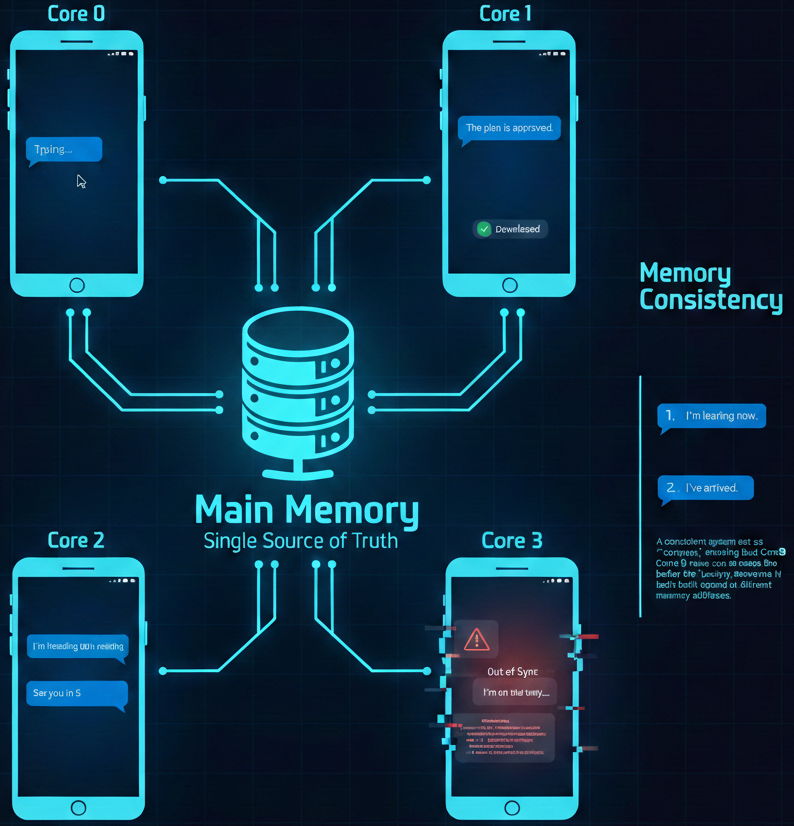
Imagine you and three friends are planning a dinner. In our hardware world, Main Memory is the official server history of your chat. It is the single source of truth, but it’s far away and slow to access. To speed things up, each of your phones has a Private Cache—a local copy of the messages stored right on your device.
- Cache Hit: You open the app and see the dinner location instantly. It’s already on your screen.
- Cache Miss: Your app is empty. You have to wait for your phone to “fetch” the history from the server.
The nightmare starts when someone changes the plan. If your friend updates the time from 7 PM to 8 PM, but your phone doesn’t refresh, you’re going to show up an hour early to an empty table. Keeping everyone’s local screen in sync with the latest message is what we call Cache Coherence.
Meet MESI: The Rules of the Chat
To manage this, we use a protocol called MESI. Think of it as the “traffic lights” for your data states:
- Modified (M): You are currently typing a message. You have the only “true” version of that draft. Until you hit send, the server doesn’t know it, and your friends can’t see it. You “own” that data.
- Exclusive (E): You just downloaded the latest dinner time. You’re the only person in the group who has checked the chat so far. Because you know you’re the only one with a copy, if you decide to change the time, you can do it instantly without asking anyone else for permission.
- Shared (S): Everyone in the group has the same dinner time on their screens. You can all read it, but the rules are strict: if you want to change it, you have to send an “Invalidate” signal to everyone else’s phone first, forcing them to clear their screens.
- Invalid (I): Your copy is stale. Maybe your signal dropped while the group was making a change. You can’t trust what’s on your screen and must fetch a fresh update from the server.
Coherence vs. Consistency: The “What” vs. the “When”
This is where students often trip up.
- Coherence is about a single message (like the dinner time). It ensures that every core eventually sees the same value for that one specific address.
- Memory Consistency is the broader contract regarding all messages. It defines the order in which you see different updates.
Think of it like this: If I send two texts—”I’m leaving now” followed by “I’ve arrived”—a consistent system ensures your phone doesn’t show “I’ve arrived” before “I’m leaving.” If the order flips, the logic of the program breaks.
The Mission of SCL
In my current work, my team and I are verifying shared caches that support massive AI and ML workloads. When you scale from four friends in a chat to many cores trying to update matrix data simultaneously, the “race conditions” become incredibly complex. Let me know in comment section if any specific topic you want to read about.
Don’t let your expertise go Invalid – subscribe to stay coherent with the lab and keep your knowledge clean and exclusive.
–Hardik Makhaniya


Leave a Reply